

Most founders treating LinkedIn as a broadcast channel are leaving their most reliable pipeline lever unpulled. A LinkedIn content strategy for founders is not about posting more often or chasing follower counts. It is about building a system where the right content attracts the right buyers, and every engagement signal is converted into a qualified conversation.
Key Takeaways
- Pillars beat topics: Choose three content pillars mapped to buyer intent and funnel stages, not audience curiosity alone. A wide audience that never buys is a vanity metric with extra steps.
- Engagement is the start, not the end: The real pipeline work happens after someone comments or visits your profile. Without a defined handoff workflow, your best-performing posts produce reach, not revenue.
- Measure pipeline proximity, not impressions: Track profile visits from ICP job titles, DM-to-call conversion rate, and content-influenced pipeline. Follower growth tells you almost nothing about sales readiness.
What is a LinkedIn content strategy for founders?
A LinkedIn content strategy for founders is a structured system that uses the founder's personal voice to attract a defined ideal customer profile, build credibility through repeated contact, and route engagement signals into sales conversations. It differs from a company page plan in that it treats the founder's profile as a revenue asset, not a broadcast channel. For a deeper look at content marketing ROI and strategy effectiveness, the case for founder-led organic content over paid acquisition is well documented.
Why the founder's voice outperforms the company page
The performance gap between personal profiles and company pages is not marginal. Personal profiles generate approximately 8x more engagement than company pages posting identical content, and employee-shared content drives roughly 5x more leads than brand-page posts. The reason is structural: buyers evaluate trust and expertise before they evaluate a product. A founder who writes with specificity about the problems they are solving does something no product page can do. It makes expertise feel real and the relationship feel possible.
Pro Tip: Optimize your profile banner, headline, and about section around your buyer's problem, not your own biography. When a prospect visits after reading a post, the profile must convert that curiosity into a connection request or DM.
The difference between a content plan and a content strategy
A content plan answers the question: what will I post this week? A content strategy answers the question: what business outcome does each post move forward, and what happens after someone engages? Most founders have the former and mistake it for the latter. The plan is the calendar. The strategy is the pipeline system underneath it.
Step 1: Define the three content pillars that serve both audience and pipeline
Content pillars are the thematic categories that give your LinkedIn presence coherence and predictability. The mistake most teams make here is choosing pillars based on what they enjoy writing rather than what their buyer needs to believe before they sign a contract. A well-documented framework on LinkedIn content marketing strategy for 2025 proposes a three-pillar model worth examining: one pillar builds the audience, one targets the ICP directly, and one drives the close.
How to audit your current topics against buyer intent
Pull your last twenty posts and sort them into three buckets: broad industry commentary, ICP-relevant insight, and proof of results. In practice, most founders discover they are heavily weighted toward the first bucket. Broad industry content builds followers efficiently but creates almost no pipeline signal because it attracts everyone, including people who will never buy. The fix is not to stop writing industry content. It is to ensure at least two of your three pillars create content that a qualified buyer finds specifically relevant to a decision they are trying to make.
Matching pillars to your sales funnel stages
- Awareness pillar: Industry POV, counterintuitive takes, and sector trends. Attracts a wide audience and seeds initial credibility with people not yet in-market.
- Consideration pillar: Problem-specific insights that map directly to your buyer's day-to-day pain. This is where ICP-aligned prospects self-identify by commenting or sharing.
- Conversion pillar: Results, case studies, frameworks, and lessons from real engagements. Provides social proof without a formal sales pitch. This pillar is the one most founders skip entirely.
Common pillar mistakes that grow followers but kill conversion
100% awareness content — What It Produces: High follower growth · What It Costs You: Near-zero inbound leads. Recommended Fix: Cap awareness pillar at 40% of posts.
Generic tips and listicles — What It Produces: Likes from peers and competitors · What It Costs You: No ICP self-selection. Recommended Fix: Anchor every tip to a specific buyer problem.
No proof or results content — What It Produces: Thought leader positioning only · What It Costs You: Long trust-building cycle, slow pipeline. Recommended Fix: Post one results-oriented piece per fortnight.
Founder-journey posts only — What It Produces: Personal brand growth · What It Costs You: Audience that resonates but never buys. Recommended Fix: Map journey stories to buyer-relevant outcomes.
Step 2: Build a repeatable weekly posting cadence without burning out
Posting frequency matters more than most founders expect. Pages and profiles that post weekly grow followers significantly faster than those posting monthly, and individual creators see their strongest results at three to five posts per week. The challenge is not knowing this. The challenge is sustaining it without content creation consuming the time a founder should be spending on product and customers.
The three post formats that consistently outperform on LinkedIn
- Document carousels: Native document posts average a 7% engagement rate, the highest of any LinkedIn format. Use them for frameworks, before-and-after comparisons, and step-by-step processes your buyer would save and share.
- Text-native posts: Long-form text posts between 1,300 and 1,600 characters consistently outperform shorter updates on depth of engagement. Lead with a single provocative or counterintuitive statement, then deliver the argument in short paragraphs.
- Proof posts: Short, specific outcome stories framed around a problem your ICP recognises. These do not need to be formal case studies. A three-paragraph summary of what changed for a client and why is sufficient to trigger DMs from prospects in the same situation.
"Pipeline from LinkedIn is not a reach problem, it is a system problem. The founders who book consistent calls run all three funnel layers and walk every qualified signal to a conversation." — Pattern observed across high-performing founder-led LinkedIn content systems
A four-week batching system founders can set up in one afternoon
Content batching is the practice of planning, drafting, and scheduling multiple posts in a single focused session rather than producing content reactively. The operational pattern that works: block one ninety-minute session every two weeks. In that session, draft six posts across your three pillars, two per pillar. Schedule them for the following fortnight. Review engagement from the prior batch before the next session to identify which pillar is driving the most ICP-relevant interactions.
Founders using AI-assisted drafting tools to accelerate the first-draft stage consistently report significant reductions in production time without losing their authentic voice. The rule of thumb here: AI produces the scaffold, the founder supplies the specific experience that makes the content credible and non-generic.
Step 3: Convert LinkedIn engagement into qualified pipeline
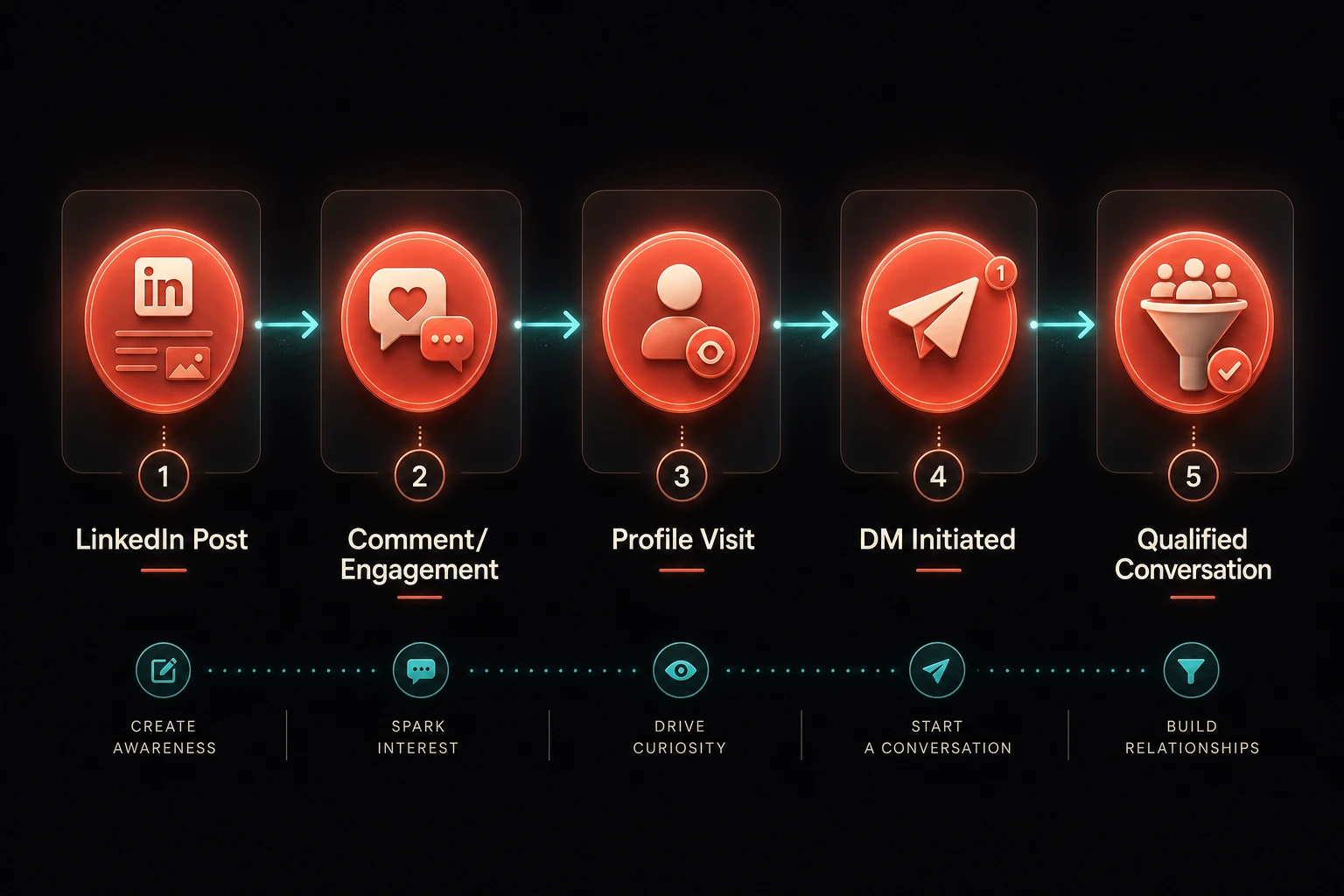
Every competitor guide stops at the content layer. The gap they all leave open is the answer to one question: what do you do after someone engages? A comment is not a lead. A profile visit is not a pipeline entry. Converting LinkedIn engagement into revenue requires a defined workflow with specific trigger conditions, a trust-preserving outreach approach, and a system that scales without the founder manually tracking every interaction.
How to identify high-intent signals in your post comments and DMs
- Substantive comments: A commenter who adds a specific data point, shares a counterexample, or describes a problem they face is signalling domain familiarity. These are your warmest leads. A peer sharing an opinion is not.
- Profile visits from ICP roles: After publishing a consideration or conversion pillar post, check who visited your profile in the 48-hour window. A VP of Operations at a 50-person B2B company visiting your profile after reading your post on operational inefficiency is a direct buying signal.
- Post saves and shares: LinkedIn added saves and send data to analytics in late 2025. A post being shared privately via DM means a professional found it valuable enough to send to a specific colleague, the exact behaviour that indicates your content is reaching decision-making conversations you cannot see.
- Repeat engagers: Someone who has commented on two or more posts in a thirty-day period is actively following your work. They are pre-warmed. An approach to this person is not cold outreach, it is the continuation of a conversation already in progress.
The engagement-to-conversation workflow that preserves trust
The sequence that works in practice: reply to every substantive comment within the post thread first. Make your reply genuinely useful, not a prompt to book a call. Then connect with the ICP-shaped commenter or profile visitor. Send a connection note referencing the specific post or comment. Once connected, wait for a second interaction before moving to a DM. The DM, when it comes, should open a dialogue, not pitch a product. "I noticed you were working through [specific problem from their comment]. We ran into the same situation with a client recently, here is what worked. Happy to share more if useful." That framing preserves trust and earns the response.
Watch Out: Sending a pitch immediately after a connection request is the single fastest way to destroy the credibility that your content spent weeks building. The comment is the door-opener. The conversation is where pipeline actually starts.
Using automation to scale follow-up without losing the founder voice
Manual tracking of post engagements works at low volume but breaks down past three or four posts per week. The solution is a lightweight CRM or tracking system where high-intent signals are logged as they occur. Each week, the founder or a designated team member reviews the signal log, prioritises the top five to ten interactions, and executes personalised outreach against each one. An automation layer can handle the signal capture and CRM routing, so no qualified engagement falls through. The founder's time is then reserved for the conversation layer only, the part where authenticity and judgment cannot be delegated.
How to measure whether your LinkedIn strategy is actually working
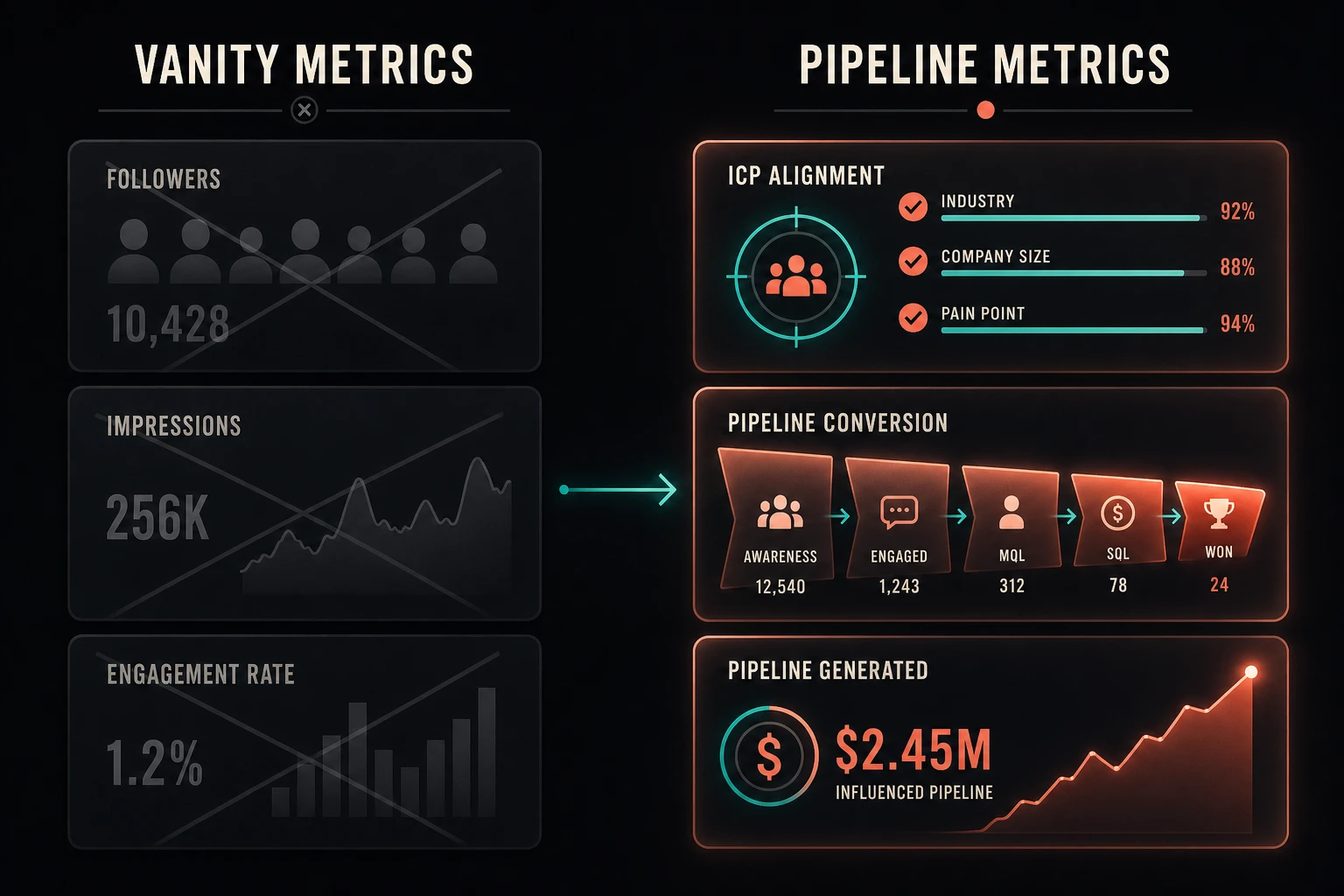
The metrics most founders track, impressions, follower growth, and post likes, measure reach, not revenue proximity. A post with ten thousand impressions and zero ICP-quality comments has underperformed a post with two hundred impressions and three substantive comments from heads of operations at target-sized companies. Replacing vanity metrics with pipeline-proximate indicators is not a minor adjustment. It is the difference between knowing your strategy is working and hoping it is.
Vanity metrics versus pipeline metrics: what to track and what to ignore
Impressions — Category: Vanity · What It Tells You: How many feeds your post entered. Recommended action: Track trend only. Do not optimise for this directly.
Follower growth — Category: Vanity · What It Tells You: General audience expansion. Recommended action: Segment by ICP job title monthly to assess quality.
ICP profile visits post-publish — Category: Pipeline · What It Tells You: Whether your content triggers buyer curiosity. Recommended action: Log every ICP-role visit within 48 hours of posting.
Comment quality from ICP roles — Category: Pipeline · What It Tells You: Whether the right buyers are engaging. Recommended action: Score comments weekly. Substantive ICP comments trigger outreach sequence.
DM-to-call conversion rate — Category: Pipeline · What It Tells You: Whether your engagement workflow converts. Recommended action: Track monthly. Below 20% signals a messaging or timing problem.
Content-influenced pipeline — Category: Pipeline · What It Tells You: Deals where prospect cited or engaged with content. Recommended action: Note in CRM at deal creation. Review quarterly for pillar effectiveness.
A monthly LinkedIn review template for founders
- Post performance by pillar: Which pillar generated the most ICP-quality engagement? Increase frequency for that pillar in the next month.
- Signal-to-outreach conversion: Of the high-intent signals logged, what percentage resulted in a connection and follow-up conversation? Below 50% indicates a process gap, not a content gap.
- DM-to-call pipeline: How many discovery calls in the month were sourced from LinkedIn engagement? Track the originating post and the time elapsed between engagement and booked call.
- Profile visit sources: Which posts drove the most ICP-role profile visits? Use this to identify which content formats and topics create the strongest buyer pull.
Frequently Asked Questions
How often should a founder post on LinkedIn to build an audience?
Three to five posts per week is the range where individual creator profiles see their strongest results on LinkedIn. Below twice per week, the algorithm deprioritises the profile and feed presence becomes intermittent. Founders with limited bandwidth should commit to three well-planned posts rather than attempting daily posting without a system. Consistency over a ninety-day period matters more than peak frequency in any single week.
What types of LinkedIn posts perform best for B2B founders?
Native document carousels generate the highest engagement rate of any LinkedIn format. Long-form text posts between 1,300 and 1,600 characters outperform shorter updates on depth of engagement and comment quality. Proof posts, short outcome stories anchored to a buyer-relevant problem, consistently generate the highest-quality pipeline signals. The best-performing founder accounts mix all three formats across their weekly cadence rather than defaulting to a single format.
How do you turn LinkedIn content into actual pipeline or revenue?
The conversion happens through a defined engagement-to-outreach workflow, not through the content itself. After a post publishes, monitor for substantive comments from ICP-role accounts, profile visits from target buyer titles, and post saves. Connect with high-intent engagers and reference the specific interaction in your connection note. Once connected, open a dialogue based on the problem they signalled, not a product pitch. Log each interaction in a CRM and track it through to a booked discovery call. The post creates the signal. The workflow converts it.
What is a content pillar and how should founders use them on LinkedIn?
A content pillar is a defined thematic category that gives your LinkedIn content predictability and strategic coherence. Founders should operate three pillars: one awareness pillar covering broad industry POV, one consideration pillar addressing ICP-specific problems, and one conversion pillar built around proof, results, and frameworks. The pillar mix should be weighted toward the middle of the funnel, with no more than 40% of posts allocated to the awareness pillar. Pillars should be reviewed monthly against the pipeline metrics they produce, not the engagement numbers.
Build the System, Not Just the Content
A LinkedIn content strategy for founders only produces revenue when the engagement-to-pipeline handoff is treated as a first-class part of the system, not an afterthought. Define your three pillars with buyer intent in mind, build a batching cadence you can sustain, and install the workflow that moves every high-intent signal into a qualified conversation. That is the complete system. Content without the conversion layer is brand-building. Content with it is founder-led growth.
Start with your pillar audit this week. Map your last twenty posts against your three funnel stages, identify the gap, and restructure your next batch accordingly. Once the content layer is working, add the engagement-to-CRM workflow and begin tracking pipeline-proximate metrics monthly. The compounding effect becomes visible around the three-month mark for most founders who execute consistently.
If you would rather not build the signal capture and outreach layer yourself, see how Signal House runs lead generation and outreach for founders, so every high-intent signal turns into a conversation without you tracking it by hand.